Hidden in the countryside near Balscadden, Tobar na Súl carries a remarkable story of desecration, disappearance and miraculous return
There is a quieter Dublin beyond the Georgian squares, crowded streets and familiar monuments of the capital.
Travel north through Fingal, beyond Balbriggan and towards the border with County Meath, and the landscape begins to tell a different kind of history. Here, the past is not always announced by plaques or preserved behind museum glass. Sometimes it survives in a field name, an old road or a spring of water hidden beneath a whitethorn bush.
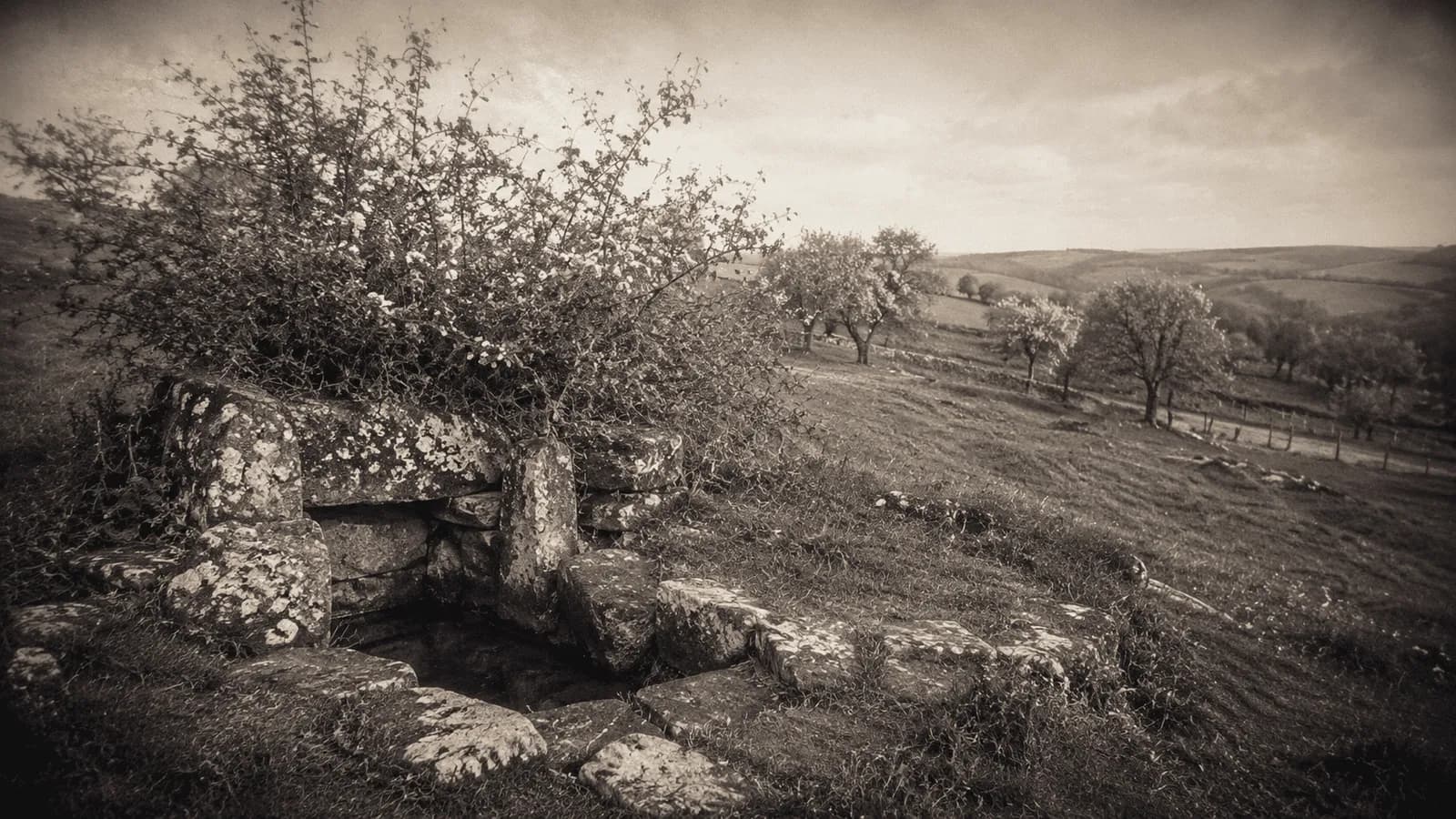
One such place is Tobar na Súl, also recorded as Tubbersool or Tobersool, a holy well in the countryside near Balscadden.
Its Irish name is generally understood to mean the Well of the Eyes, and generations of local people believed its water could relieve eye complaints. Yet the healing tradition is only one part of its story.
According to folklore collected in north County Dublin during the 1930s, Oliver Cromwell once stopped at the well, washed his feet in its water and allowed his horses to foul it. The spring immediately dried up.
It remained dry, the story says, until a priest blessed the site and the water began to flow once again.
It is a tale involving one of the most feared names in Irish history, but how much of it should we believe?
A Well Beneath the Whitethorn
The oldest surviving descriptions of Tobar na Súl do not present it as a grand religious monument.
It was described simply as a spring in the middle of an orchard, with a whitethorn growing above it. Its water drained towards another well beside the road.
That modest description is important. Many of Ireland’s holy wells were never elaborate structures. Their significance came from the water, the surrounding landscape and the customs associated with them.
Some were visited on the feast day of a particular saint. Others were believed to cure specific ailments. People might walk around them while praying, drink the water or apply it to an injured part of the body.
At Tobar na Súl, the traditional cure concerned the eyes. The name of the well preserved the belief so effectively that even after regular pilgrimages declined, the place itself continued to be known as the Eye Well.
It has also been associated locally with St Brigid, whose feast day falls on 1 February, although Tobar na Súl appears to have remained its most distinctive name.
The Schoolchildren Who Preserved Dublin’s Folklore
The Cromwell story survives because of one of the most ambitious cultural projects undertaken in twentieth-century Ireland.
Between 1937 and 1939, schoolchildren across the Irish Free State were encouraged to collect stories, customs, cures, songs, place names and memories from parents, grandparents and elderly neighbours.
More than 50,000 children from approximately 5,000 schools took part. Their handwritten work became known as the Schools’ Collection and is now preserved by the National Folklore Collection at University College Dublin.
The project captured a layer of Irish history that might otherwise have disappeared. It did not simply record famous national events. It preserved the histories of individual fields, wells, ruins, crossroads and families.
Tobar na Súl appears more than once in the north Dublin material.
In an account collected through Balscadden school, a local man named Mr Howard described the well and said the information had come down through his grandfather. A second version, recorded through the school at Naul, repeated the essential details: Cromwell polluted the spring, the water vanished, a priest blessed it and the flow returned.
The appearance of the story in more than one local account demonstrates that it formed part of the area’s shared tradition.
That does not prove the event happened, but it does prove that people around Balscadden had been telling the story long before it was written down.
Did Cromwell Really Visit the Well?
This is where a local historian must separate geographical possibility from documentary evidence.
Oliver Cromwell arrived in Dublin in August 1649 at the head of a powerful Parliamentarian army. Within weeks, his forces were moving north towards Drogheda, where one of the most infamous episodes of the Cromwellian conquest took place in September.
Balscadden and nearby Gormanston lie within the wider corridor between Dublin and Drogheda. Local traditions around Gormanston also connect Cromwell with the district, including stories that he approached Gormanston Castle before continuing north.
It is therefore entirely possible that Cromwell’s army passed through or close to the area.
What has not been found is a contemporary military letter, diary or estate record confirming that Cromwell personally visited Tobar na Súl, removed his boots and washed his feet in the spring.
The honest historical verdict is that the story is plausible in location but unproven in detail.
That distinction does not make the tale worthless. Folklore is not merely failed factual history. It records how communities remembered the past, whom they blamed and what meanings they attached to particular places.
Why Cromwell Appears in So Many Local Legends
Across Ireland, ruined castles, damaged churches, old roads and mysterious earthworks have often been attributed to Cromwell.
He could not possibly have visited every site connected with his name. In many cases, “Cromwell” became a convenient term for Parliamentarian soldiers, the wider conquest or even destruction that occurred at a different time.
Yet his appearance in local folklore is understandable.
The military campaigns beginning in 1649 were followed by executions, confiscations, forced displacement and a radical transfer of land. Cromwell’s name became shorthand for invasion, religious persecution and the destruction of an established way of life.
At Tobar na Súl, that national trauma was reduced to a single, vivid act.
A sacred place was violated. The water disappeared. The community’s spiritual order was broken.
Then a priest arrived, blessed the well and restored it.
The story is therefore about more than Cromwell washing his feet. It is a miniature account of desecration followed by recovery. The conqueror can temporarily silence the spring, but he cannot prevent its eventual return.
For the people who preserved the tale, that may have mattered more than whether every physical detail could be proven.
Water, Memory and Resistance
There is another striking feature in the story: Cromwell does not destroy a castle, defeat an army or burn a village.
He attacks water.
A spring is one of the smallest features in a landscape, but it can also be one of the most enduring. Buildings collapse and roads are redirected, yet water continues to rise from the ground.
Holy wells occupied an unusual position in Irish life. They were part religious site, part source of folk medicine and part communal meeting place. Their traditions frequently survived periods when Catholic worship was restricted or pushed away from formal church buildings.
To pollute such a place was therefore a powerful symbol. To see it restored was equally powerful.
The whitethorn growing above Tobar na Súl adds another layer to the image. Thorn trees have long been associated with sacred and supernatural places in Irish tradition. A solitary whitethorn beside a well would have marked the location even when there was little stonework or signage to guide a visitor.
The tree, the water and the story worked together as a kind of local archive.
A Surviving Piece of Rural Dublin
Tobar na Súl is not one of Dublin’s major tourist attractions, nor should it be treated as one. The well is associated with private land, and anyone attempting to locate it should respect property boundaries and seek permission.
Its importance lies partly in its obscurity.
Modern Dublin history is too often confined to the city centre, as though the county beyond the canals and suburbs existed only as background scenery. Yet the countryside of Fingal contains layers of religious, agricultural and political history that are every bit as revealing as the capital’s better-known buildings.
Tobar na Súl allows us to see several of those layers at once.
There is the old belief in healing water. There is the religious association with St Brigid. There is the memory of Cromwell’s campaign. There is the priest who restores what the invader had defiled. Finally, there are the schoolchildren and local residents who ensured the story survived into the modern age.
The Truth Within the Legend
Did Oliver Cromwell really wash his feet in a holy well near Balscadden?
We cannot say that he did.
No responsible historian should turn a local tradition into a documented event simply because it makes a compelling story.
What we can say is that Tobar na Súl was a recognised healing well, that local people associated its water with remedies for the eyes and that the Cromwell story was firmly established in the district by the time it was recorded in the 1930s.
The legend also places Cromwell within a landscape through which his army may well have travelled on its way from Dublin towards Drogheda.
History is not found only in official correspondence or military reports. It also survives in the stories communities tell about the places around them.
Somewhere in the countryside near Balscadden, a spring became a symbol of violation, faith and endurance. Cromwell arrived, the water vanished and, after a blessing, the well began to flow again.
Whether the story is literal truth or inherited memory, Tobar na Súl remains one of north County Dublin’s most intriguing hidden histories.